
Introduction
Imagine if your money could make money while you sleep. Sounds like a dream, right? Well, it’s not magic—it’s compound interest, and it’s one of the most powerful forces in the universe. Albert Einstein supposedly called it the “eighth wonder of the world,” and Warren Buffett attributes most of his wealth to understanding this concept early.
As a teenager, you have something that even billionaires envy: time. And when it comes to compound interest, time is your superpower.
What Is Compound Interest?
Compound interest is interest that earns interest. Let me break that down:
Simple Interest: You invest $100 at 10% interest. After one year, you have $110. After two years, $120. The interest is always calculated on your original $100.
Compound Interest: You invest $100 at 10% interest. After one year, you have $110. But in year two, you earn 10% on $110 (not just $100), giving you $121. In year three, you earn 10% on $121, giving you $133.10.
See the difference? With simple interest, you earned $30 over three years. With compound interest, you earned $33.10. That extra $3.10 might not sound like much, but over decades, it becomes MASSIVE.
Why Should Teens Care?
Here’s where it gets exciting. Let’s look at two fictional investors:
Sarah starts investing at age 16. She puts in $2,000 per year until she’s 26 (10 years total = $20,000 invested), then stops adding money. Her money grows at 8% annually until she’s 65.
Mike waits until he’s 26 to start. He invests $2,000 per year EVERY YEAR from age 26 to 65 (40 years total = $80,000 invested).
At age 65:
- Sarah: $1,083,000
- Mike: $560,000
Sarah invested $60,000 LESS than Mike but ends up with nearly TWICE as much! That’s the power of starting early and letting compound interest work its magic.
The Math Made Simple
Don’t worry, you don’t need to be a math genius. Here’s the formula:
Final Amount = Principal × (1 + Rate)^Time
Where:
- Principal = Your starting money
- Rate = Interest rate (as a decimal, so 8% = 0.08)
- Time = Number of years
- ^ = “raised to the power of” (multiplying by itself)
But honestly? Use a compound interest calculator online. The important thing is understanding the concept, not doing the math by hand.
Real-World Examples
The 16-Year-Old Investor
Emma gets a part-time job at 16 and invests $100/month ($1,200/year) in a simple index fund earning 7% annually. By age 65, that money grows to approximately $1.2 million.
The 30-Year-Old Investor
Jake waits until he’s 30 with a “real job” and invests $300/month ($3,600/year) at 7% annually. By age 65, he has approximately $580,000.
Emma invested HALF as much per month but started 14 years earlier. Result? She has more than DOUBLE what Jake has. Time beats money.
Try It Yourself
Let’s do a quick exercise:
-
The Penny Doubling: Would you rather have $1 million right now, or a penny that doubles every day for 30 days?
Answer: The penny becomes $10.7 million! That’s compound growth in action.
- Calculate Your Potential: Use any online compound interest calculator and plug in:
- Start with $1,000
- Add $100/month
- 7% annual return
- See what happens over 10, 20, 30, and 40 years
- The 1% Challenge: See how much difference 1% makes. Calculate returns at 6% vs. 7% vs. 8% over 40 years. Spoiler: it’s HUGE.
Key Takeaways
- Start NOW: Even small amounts add up over time thanks to compound interest
- Time is your biggest advantage: Starting at 16 beats starting at 30, even if you invest less
- Consistency matters: Regular contributions, even small ones, create massive results
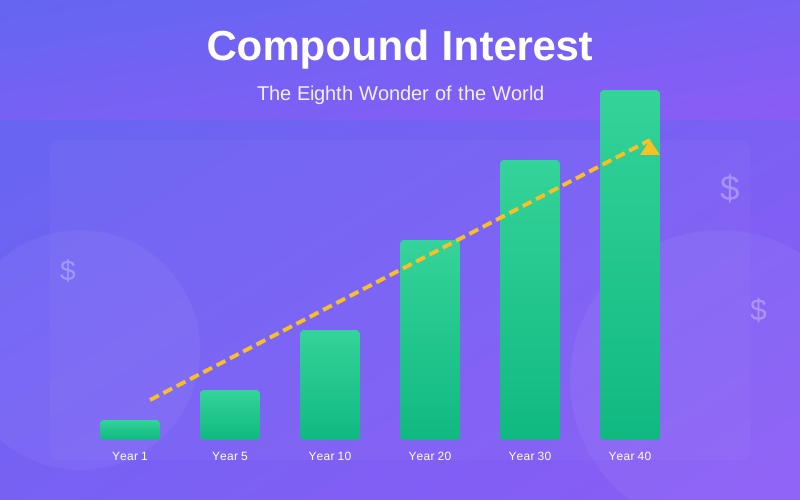
- Be patient: Compound interest works slowly at first, then accelerates dramatically
- Don’t interrupt it: Taking money out stops the compounding magic
- Rate matters: Even a 1% difference in returns makes a massive difference over decades
Further Reading
- Investopedia: Compound Interest - Detailed explanation with formulas
- The Motley Fool: Compound Interest Examples - Real-world examples
- SEC Investor.gov - Official compound interest calculator
- Book: “The Compound Effect” by Darren Hardy - How small actions compound over time
Remember: This article is for educational purposes only. Not financial advice. Investing involves risk, including loss of principal. Past performance doesn’t guarantee future results. The examples above use hypothetical returns for illustration purposes.